Episode Analysis
Silo Season 3's Penultimate Turn Rewrites the Finale Questions
Silo's penultimate episode shifts the mystery around the Algorithm and the Before Times, sharpening the questions heading into the finale.
By Editorial Desk ·

Spoiler warning: This analysis reveals major events from Silo Season 3, Episode 9, Farewell.
The Algorithm just became a much stranger problem
For three seasons, Silo has trained viewers to distrust every tidy answer. Farewell keeps that habit in excellent shape. During Bernard Holland's negotiation with the Algorithm, he decides its responses feel less like an infallible machine and more like a frustrated person, or group of people, operating from Silo 1 [1, 3].
That deduction changes the question without completely answering it. If Bernard is right, the system controlling life underground may have human judgment behind it. The episode does not identify those people, explain their authority, or prove how much of the system they directly control. It simply turns the Algorithm from a sealed black box into a door with somebody possibly standing on the other side [1, 3].
That is prime finale fuel. The mystery is no longer only about what the Algorithm was designed to do. It is also about who may be using it, what they know, and whether its rules reflect a fixed survival program or decisions still being made in the present [1, 3].
Silo 1 now sits at the center of two different kinds of power. It is the place Bernard believes may house the people behind the Algorithm, and it is part of the old-world separation suggested by the Before Times story. The episode does not confirm that these threads have one explanation, but placing them beside each other makes that overlap difficult to shrug off [1, 2, 3].
The Before Times finally go boom
The episode's other big swing lands in the Before Times. Three years after the earlier flashback material, Daniel and Helen are expecting a child when they attend the public unveiling of the silo system. The event ends with a nuclear explosion, giving the season its clearest visual link yet between the old world and humanity's life underground [1, 2, 3].
The careful word is link, not proof. The sequence strongly suggests that the blast pushed people underground and separated Daniel and Helen into Silo 1 and Silo 18, but the locked evidence does not establish who caused it, whether it was the only attack, or whether the public unveiling concealed a larger plan. Silo has shown viewers the flash; it has not handed over the full incident report [1, 2].
That restraint makes the reveal more useful than a simple origin-story checkbox. Daniel and Helen's separation now appears tied to the birth of the silo order, while the nuclear event gives the finale a concrete disaster to interrogate. The remaining puzzle is not merely how the silos were built. It is how emergency shelter became a system of division, secrecy, and control [1, 2, 3].
The parallel storytelling does some nimble work here. Bernard is questioning authority in the present just as Daniel and Helen encounter the event that appears to launch the underground world. One thread asks who is running the system now; the other asks what kind of crisis gave that system its first claim to legitimacy. The episode connects the questions without pretending it has solved either one [1, 2, 3].
Bernard leaves one last dangerous idea behind
Bernard turns himself in to Camille Sims as a calculated distraction so the rebellion can continue its move against Judicial. He later dies outside the silo, but not before reaching his conclusion about the Algorithm. His final contribution is therefore not another command from IT; it is a destabilizing possibility that can outlive him [1, 3].
That possibility also sharpens Camille's role. The episode shows her willing to use Vitamin D+, the memory-suppressing drug, on the population if she believes it is necessary to save humanity. Her position is not presented as casual cruelty. It is a conviction that control can be justified as protection, which puts her directly inside the show's oldest argument: who gets to decide what people are allowed to know [3].
Camille therefore enters the finale carrying more than institutional power. She has a theory of survival that can excuse erasing memory, while the rebellion is trying to break into the machinery that keeps truth compartmentalized. The clash is not simply order versus chaos. It is a fight over whether people can be protected by withholding the very history that would let them judge the danger for themselves [3].
What the finale now has to untangle
Farewell does not close the mystery; it rearranges the evidence board. Bernard's deduction points toward human agency inside Silo 1. The Before Times sequence strongly connects a nuclear catastrophe with the move underground. Camille is prepared to trade memory for order. Each development raises the same uncomfortable possibility from a different angle: the silos may be governed not only by old rules, but by people still choosing how those rules are enforced [1, 2, 3].
The finale now has three wonderfully thorny questions waiting at the door. Who is behind the Algorithm? What exactly happened around the nuclear explosion? And can a rebellion built on discovering the truth survive leaders who see secrecy as a form of rescue? Silo has not answered those questions yet—but it has finally made them impossible to ignore [1, 2, 3].
Editorial disclosure
Researched and drafted with Vertex AI from the sources listed below, then reviewed and revised by ShowVision's publisher before publication.
More images — may contain episode spoilers


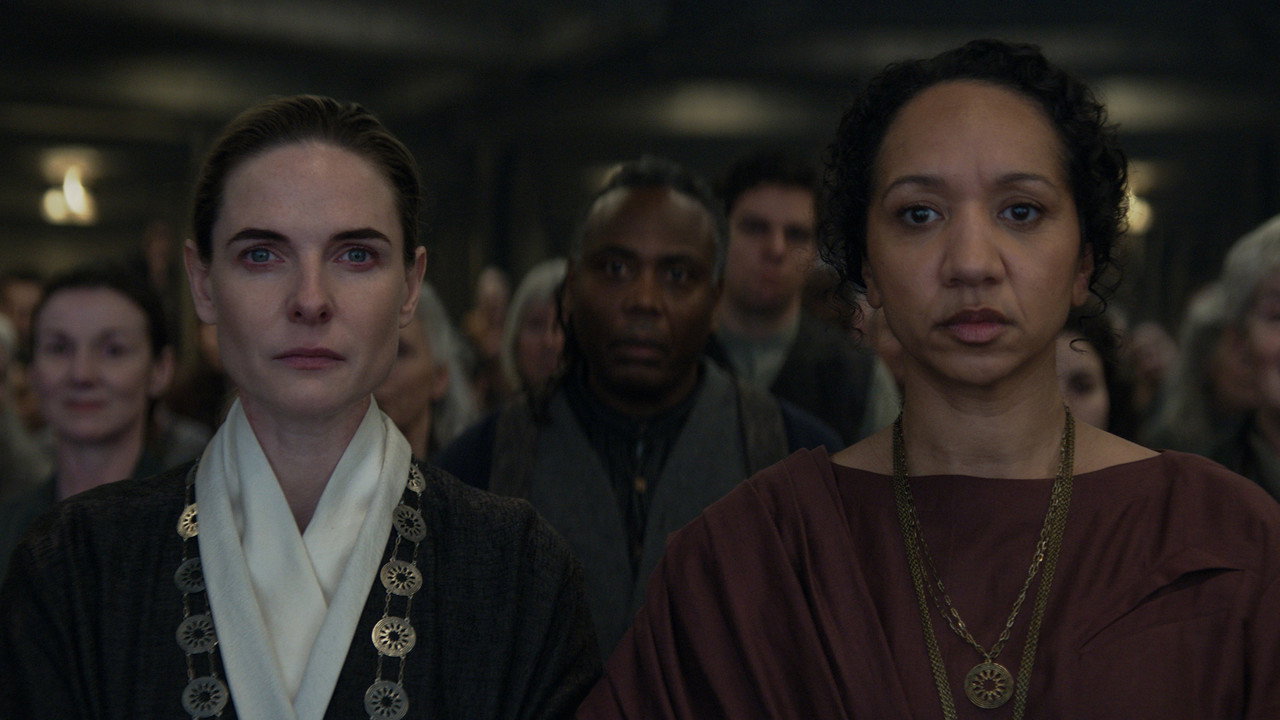
Silo episodes and season status
Continue from this story to the Silo show page for its current season status, episode guide, next release information, cast, and watchlist tools.